
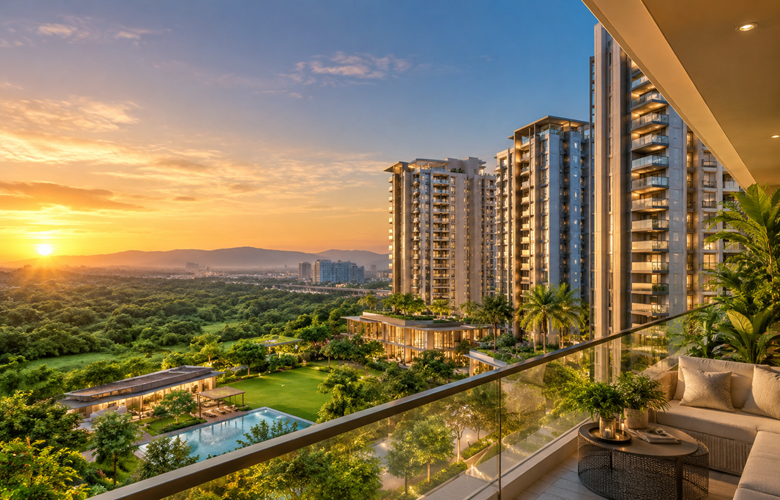
Haryana’s building code lets a group housing project cover 35% of its site. Several new launches on Golf Course Extension Road now advertise footprints closer to 19%.
That gap is the entire story behind a phrase that started showing up in Gurugram sales material this year: Bay Living in Gurugram. The concept comes from Miami, where it means something quite precise, but is now being adapted to a corridor about 1,100 kilometers from the nearest coastline.
The timing is not accidental. ANAROCK’s Q1 2026 residential viewpoints put NCR’s price appreciation at roughly 15% year-on-year, the steepest among the top seven cities, with homes above ₹1.5 crore taking 53% of all new launches. When every project in a corridor comes with imported stone, a large clubhouse, and a home-automation panel, the differentiator becomes the one thing you can’t retrofit: what you see when you open the balcony door.
Which raises a question worth asking before anyone pays a premium for it. In a landlocked sector, who guarantees the view?
Where the phrase comes from, and what it is actually selling
In South Florida, “bay view” covers everything from a sliver of water between two towers to a full horizon of water, skyline and sky. Buyers there learned the difference the expensive way, and the vocabulary that grew up around it is architectural rather than lyrical: building placement, shoreline geometry, setbacks, protected view corridors, flow-through floor plans, terrace depth.
Look at how the concept gets built and the logic becomes clear. Miami’s recent Bayfront schemes keep breaking a single large volume into separated towers linked by podiums, specifically so that sightlines to the water survive the development itself. Others go low and wide instead, trading height for frontage. Different answers, same problem: how do you stop the building from eating its own view?
Underneath it all sits one fact doing most of the work. Nothing can be built in the bay. The foreground is permanently unbuildable, which means the view is not a feature of the building at all. It is a feature of what the building faces, and whoever develops the next plot can’t take it away.
That permanence is the product. Strip out the water and Bay Living in Gurugram reduces to a planning position: orient homes outward towards something that will stay open, and accept the constraints that requires.
A coastal idea in a landlocked corridor
Gurugram has no bay. So the imported concept has to find a local substitute for the unbuildable foreground, and developers have settled on two: the open ground inside the boundary wall, and the Aravalli ridge outside it.
The first is measurable, which makes it the useful one. The Haryana Building Code 2017 permits group housing to cover up to 35% of its site, with floor area ratio capped at 175%. That ceiling is what a conventional Gurugram high-rise scheme builds towards. A project claiming a 19% footprint is voluntarily giving up roughly half the ground it is allowed to occupy.
Several developments on the corridor are now positioned around some version of this. Godrej Verano in Sector 63A Gurgaon publishes a 19% building footprint across 11.36 acres with four towers, on land Godrej Properties bought outright in March 2026, with revenue potential above ₹4,500 crore. DLF The Arbor, Birla Navya, Smartworld The Edition and Sobha Crescent occupy neighboring parcels with comparable low-density positioning. Between them they now define what the corridor means by premium.
Here is the part the brochures skip. Reducing ground coverage does not reduce buildable area. Floor area ratio is unchanged, so whatever the footprint gives up, the height takes back. Fewer towers, taller towers, more homes stacked per plate. The 624 residential units recorded on the Sector 63A project’s HARERA registration sit on the same 11.36 acres, regardless of how much is landscaped.
Openness at ground level is bought with density in the air. That is a legitimate trade, and for most buyers a good one; a shaded walk to the gate beats a wider corridor on the twenty-second floor. But it is a trade, not a free gain, and it deserves to be described as one.
Does an eye-level view actually price?
The evidence is better than the marketing deserves. A 2026 systematic review published in Forests reviewed 180 peer-reviewed articles covering 440 empirical cases on how urban greenery capitalizes into housing prices. The premium is real but highly variable, which is unsurprising. The interesting finding is about measurement.
Human-scale visual metrics what a person actually sees at eye level were positively associated with prices in nearly 93% of significant cases, outperforming satellite-derived canopy measures. Resident assessments of how well green space is maintained came second. Aerial green cover, the number that looks best on a site plan, predicted price less reliably than the view from the window.
For a buyer, that reframes the site plan. An 81% open-space figure describes the plot from above. It says nothing about whether the tower opposite blocks the morning sun, or whether the tree line reads as landscape or as leftover. Both projects can print the same percentage.
The corridor numbers give the premium a size. MagicBricks put average Golf Course Extension Road pricing at roughly ₹18,887 per sq.ft. in Q1 2026, with premium stock crossing ₹22,821, asking prices, not registered transactions, so treat them as a direction rather than a benchmark. Rental yields across the belt run between 3.0% and 4.7%.
The part that is not architectural
Internal open space is a contractual fact. It sits in the license, the zoning plan and the RERA record, and a buyer can hold a developer to it.
The Aravalli horizon is a different matter, and it is the subject of an unresolved case.
In November 2025, the Supreme Court accepted a uniform definition of the Aravalli hills prepared by the Forest Survey of India, the Geological Survey of India and the court’s Central Empowered Committee: a hill is a landform rising 100 metres or more above local relief, and a range is two or more such hills within 500 metres. Ecologists objected that a purely height-based threshold would leave large stretches of the range outside protection. The court took suo motu cognizance, put its own judgment in abeyance, and in June 2026 constituted a fresh expert committee headed by the Director General of the Indian Council of Forestry Research and Education. Its report is due by 31 August 2026.
The environment ministry has been firm that the definition governs mining regulation and nothing else. Union environment minister Bhupender Yadav has said the exercise does not alter land-use classification, forest status or settlement rights, and that it will not be issued until a scientific management plan is approved. Alongside it, roughly 97 kilometers of Aravalli revenue land has been declared permanent protected forest, and the Aravalli Green Wall Project has identified 6.45 lakh hectares of degraded land, with 2.70 lakh already under restoration.
All of which is genuine conservation policy, and none of which is a sightline guarantee.
The distinction matters for anyone paying for a ridge view from Sector 63A. Protecting the Aravallis from quarrying does not protect a buyer’s line of sight to them. What is placed between a balcony and the ridge is not the range itself but a sequence of privately held, separately licensed parcels, each governed by the same building code that permits 35% coverage and 175% FAR. A hill can be protected in perpetuity and still be invisible from the fourteenth floor.
What to check before paying for the horizon
Five things separate a durable outlook from a rendered one, and four of them are on paper.
- The sanctioned building plan, not the brochure. Ground coverage is a number in the approved plan. Ask for it in writing and check it against the marketing figure. They are not always the same document.
- The RERA record. The Sector 63A project carries Haryana RERA Gurugram registration No. 53 of 2026, issued on 11 August 2026 and valid to 2 June 2033. The unit counts, phase area, and licensed extent are all recorded there. Verify on the Haryana RERA portal rather than on any sales page, including this publication’s.
- The zoning of everything in front. Pull the sector plan and look at what the intervening parcels are licensed for. A view survives at the pleasure of the neighbouring plot, and the current skyline is not a forecast.
- Which floors actually get the view. Orientation claims apply to a project. Sightlines apply to a unit. Those are different conversations, and only one of them is in the brochure.
- The absorption question. Multiple large premium schemes are scheduled onto this corridor between 2026 and 2028. Concentrated supply can stretch absorption cycles, and yields between 3% and 4.7% mean a view premium is a lifestyle purchase before it is an income one.
The line on the map
Bay Living in Gurugram, with the Miami reference removed, is an unremarkable planning decision: build on less ground, go taller, keep the rest open, and point the homes at whatever will still be there in twenty years. It is a reasonable idea. It is also, for now, a claim rather than a standard.
Whether it becomes the second depends on two things that have nothing to do with design vocabulary. The first is whether ground coverage holds when construction costs move against a project, because 19% is easy to promise at registration and harder to defend at revision. The second arrives on 31 August, when the ICFRE committee reports to the Supreme Court on where the Aravallis legally begin and end.
A view sold as permanent is only ever as permanent as the line someone draws on a map.
Read more: https://www.veranosector63gurgaon.com/blog/
FAQ
What is bay living in real estate?
Bay living is a planning approach that originated in Miami’s bayfront developments, where homes face outward toward open water rather than each other. In practice it means separated towers instead of one dense block, protected view corridors between buildings, and deep terraces with flow-through layouts. The defining feature is not the water itself but the permanently unbuildable foreground it provides. Projects importing the concept to inland markets substitute large internal open space and, in Gurugram’s case, the Aravalli ridge for the bay.
How is bay living different from a normal low-density project?
Low density usually refers to how many homes sit on a site. Bay living is about orientation and sightlines, which is a separate question. A project can be low density and still have every tower facing another tower. The bay-living test is whether homes point outward at something that will remain open, and whether the site plan protects the gaps between buildings rather than filling them. The measurable proxy is ground coverage: Haryana permits group housing to cover up to 35% of its site, so a project closer to 19% has more structural room between buildings.
Does a protected view actually add to property value?
The research says yes, with wide variation. A 2026 systematic review in Forests examined 180 peer-reviewed studies and 440 empirical cases and found a consistent positive premium from urban greenery, strongest when measured at human eye level rather than from satellite canopy data. What buyers see from a window predicted price more reliably than aerial green cover did. The caveat is that a view premium is only durable if the outlook is legally or physically protected. An open sightline over privately held, developable land is a temporary asset, not a permanent one.

Considering Godrej Verano, Sector 63A Gurgaon?
Floor plans, pricing and payment plan on request.
Related reading
How Architecture and Natural Light Influence Luxury Living in Gurgaon
Natural light shapes luxury living in Gurgaon through three key architectural choices: window orientation, glazing area and external shading. India’s national energy code assigns north-facing glass…
Read more →
Can Resort-Inspired Living Change the Way People Choose Luxury Homes in Gurgaon?
Yes, Gurgaon buyers now evaluate Resort Style Apartments in Gurgaon based on land-use data rather than amenity lists alone. In H1 2026, the average home ticket…
Read more →