
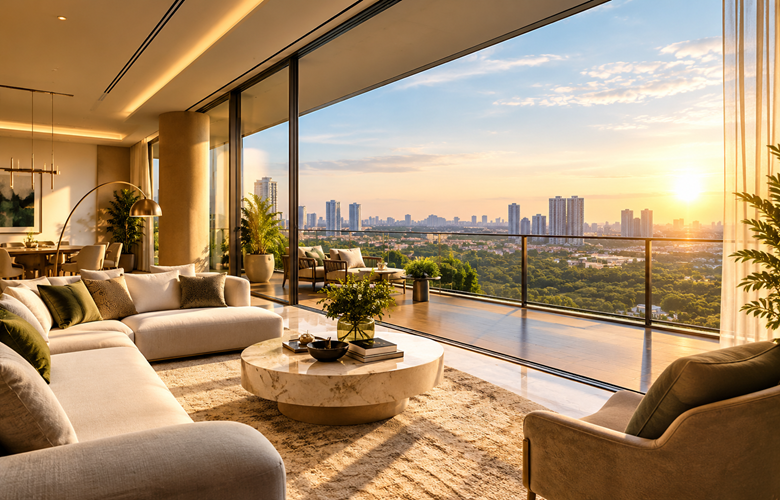
Natural light shapes luxury living in Gurgaon through three key architectural choices: window orientation, glazing area and external shading. India’s national energy code assigns north-facing glass a solar heat weighting of 0.550, compared with 1.155 for east-facing and 1.143 for west-facing glass. For New Delhi’s composite climate zone, the code also specifies openable windows covering at least 12.5% of a home’s carpet area. These factors show how Natural Light Shape Luxury Living in Gurgaon begins at the architectural planning stage, long before interior finishes and furnishings are selected.
Best Facing Flat for Sunlight in Gurgaon
The national code for energy-efficient homes rates every direction for locations at or above 23.5°N, a band that includes Gurgaon. A higher figure means more solar heat enters through each square foot of glass facing that way. Beyond north, east and west, the remaining directions score as follows:
- South-east: 1.211, the highest of all 8 directions
- South-west: 1.202
- South: 1.089
- North-east: 0.829
- North-west: 0.821
The best sunlight orientation lights the main rooms without the heaviest heat load. North-east and north-west glass brings in steady daylight at roughly two-thirds of the heat that south-east glass admits, which suits study rooms and home offices.
East Facing vs West Facing Flat
Many people believe an east-facing flat stays cooler. The code’s orientation weightings show otherwise, because east glass gains marginally more heat over the cooling season than west glass.
West rooms feel hotter for a reason the weighting does not capture. Afternoon sun arrives when the outdoor air is already warmest, so the walls and glass heat up together, while east rooms get the same sun in the morning, after the building has had the night to cool down.
Low evening sun also slips under horizontal overhangs. That is why a west face needs vertical fins, external screens, or low-heat-gain glass rather than simply a deeper ledge.
East-West Facing Flat Benefits
A flat with glass on both its east and west sides captures morning light on one end and evening light on the other, keeping the main rooms lit for more hours of the day. Openings on two opposite faces also let air move straight through the home, the simplest route to cross-ventilation.
That layout logic shows up at Godrej Verano Gurgaon, where every apartment faces east to west and light moves through the rooms throughout the day.
Window to Floor Area Ratio for Residential Buildings in India
The right window-to-floor-area ratio can improve daylight, ventilation and indoor comfort in a home. India’s residential energy code focuses on the openable window area as a proportion of the carpet area of the entire dwelling unit, rather than the total glass area of an individual room. Understanding this distinction helps explain how Natural Light Shape Luxury Living in Gurgaon, where thoughtful architecture, well-planned windows and efficient layouts can make luxury homes feel brighter, more comfortable and better connected to the outdoors.
Fixed glass does not count. A home with 2,000 sq.ft. of carpet area needs at least 250 sq.ft. of window that actually opens to meet the composite-zone minimum, and many layouts fall short with wide fixed panels and a narrow sliding shutter.
Openable window minimums in the other climate zones show how closely the rule follows the weather:
- Warm-humid: 16.66 percent
- Hot-dry: 10 percent
- Cold: 8.33 percent
The openable window rule applies to residential buildings on plots of 500 sq.m. or more.
Disadvantages of Natural Light in a Home
Unmanaged daylight brings 2 problems, heat and glare, and the national standard tackles both through the glass itself. Its visible light transmittance rule allows glass to get darker as windows get bigger:
- Windows up to 30 percent of the wall: minimum 0.27
- 31 to 40 percent: 0.20
- 41 to 50 percent: 0.16
- 51 to 60 percent: 0.13
- 61 to 70 percent: 0.11
A mostly glass wall can use a deeper tint and still keep rooms bright, while a small window needs clear glass to do its job.
Shade matters as much as tint. When the code calculates heat gain, it multiplies a window’s solar heat rating by an external shading factor, so balconies, decks, and fins make the same glass behave like cooler glass. The total heat entering through walls and windows, measured as RETV, is capped at 15 W/m² for the composite zone, with a planned tightening to 12 W/m².
Low Density Society Benefits for Daylight
Orientation and glass mean little if the next tower blocks the sky. In a low-density project, fewer buildings on the same land leave wider gaps, so more windows look at open sky instead of another façade.
At Godrej Verano Sector 63A Gurgaon, the plan has only 4 towers on 11.36 acres, with 19 percent of the land as building footprint and 81 percent as open greens. Homes look out on an open skyline framed by the Aravalli hills; UHA London designed the towers, and PL Design designed the landscape.
Checking Sunlight in a Flat Before Buying
Most advice stops at visiting a flat at different times of the day. Our team adds 5 checks that settle the question faster:
- Confirm what “facing” means. A flat sold as east-facing often refers to its main door, while daylight depends on where the windows and balconies point.
- Stand at the back wall of the deepest room with the lights off at 11 am and try reading a printed page.
- Add up the openable window area and compare it with the carpet area, using the ratio above.
- Look out of every window and ask what will stand there in 5 years: a tower, a road, or open green.
- For a project still on paper, ask for the site plan with tower positions and mark which façades face west.
“Fittings can be upgraded in a weekend. The direction your living room faces stays the same for as long as you own the home.”
Godrej Verano Floor Plans for Daylight
If daylight is high on your list, start with the plan rather than the brochure. The floor plans and unit sizes for Godrej Verano Sector 63A Golf Course Road are available at Godrej Verano, where you can request the layout for the configuration you are considering and check natural light in luxury homes against the numbers in this guide.
Read more: https://www.veranosector63gurgaon.com/blog/
Frequently Asked Questions
What is the price of Godrej Verano Sector 63A Gurgaon?
Indicative pricing starts at ₹5.91 Cr* for a 3 BHK of 2,150 sq.ft., which works out to about ₹27,500 per sq.ft. The largest listed home, a 5 BHK + S of 3,900 sq.ft., starts at ₹10.72 Cr*. A small number of penthouses are also planned, and their pricing is shared only on request.
What sizes are available for the 3 BHK + S and 4 BHK + S homes at Godrej Verano Gurgaon?
You can choose a 3 BHK + S of 2,575 sq.ft. from ₹7.08 Cr* or a 4 BHK + S of 2,950 sq.ft. from ₹8.11 Cr*. The + S marks an extra utility room beyond the bedrooms. These 2 layouts give you the middle of the range, between the entry 3 BHK and the largest 5 BHK + S residence.
What is the Godrej Verano RERA number and possession timeline?
You can look up the project under RERA number GGM/1081/813/2026/53, registered with the Haryana Real Estate Regulatory Authority in Gurugram. It is in the pre-launch stage with expressions of interest open; completion is expected in 2033, and payments follow a 20×5 plan with a unit-wise breakup available from the sales desk.
How much clubhouse space does Godrej Verano Sector 63A offer?
You get 3 separate clubhouses with more than 2.10 lakh sq.ft. of shared space, so the gym, café, and co-working lounge don’t compete for one building. Outdoors, the plan lists a resort-style pool, a yoga and meditation deck, tennis and basketball courts, a cricket practice net, a pet park and a jogging and cycling track.
How well connected is Sector 63A Gurgaon by road and metro?
You can reach Golf Course Road and the Southern Peripheral Road in about 15 minutes each, and the Sector 55-56 Rapid Metro station in a similar time. Sohna Road, NH-48 and the Delhi-Mumbai Expressway are about 20 minutes away, while IGI Airport is roughly 35 minutes from the gate for your flights and family visits.
Which schools, hospitals and offices are close to Sector 63A Gurgaon?
You will find DPS, GD Goenka and Heritage in the school belt next to Sector 63A, while Medanta and Fortis are a short drive from the gate. For work, Cyber City is about 25 minutes away and Udyog Vihar about 30 minutes, so you can reach both of Gurgaon’s main office hubs without a long daily drive.
What is natural lighting in architecture?
Think of natural lighting, or daylighting, as the planned use of windows, skylights, light wells, and external shading to light interiors with sunlight instead of lamps during the day. Good daylighting balances brightness with heat and glare, so architects balance it through orientation, window size, and glass type.
Is it good to let natural light in your house?
Yes, as long as you can control it. Daylight cuts the electricity you spend on lamps during the day, which is the whole point of the national code’s glass-clarity rule. Let light in through openings you can shade, keep direct sun off screens and polished floors, and draw blinds on west windows during summer afternoons.

Considering Godrej Verano, Sector 63A Gurgaon?
Floor plans, pricing and payment plan on request.
Related reading

Can Resort-Inspired Living Change the Way People Choose Luxury Homes in Gurgaon?
Yes, Gurgaon buyers now evaluate Resort Style Apartments in Gurgaon based on land-use data rather than amenity lists alone. In H1 2026, the average home ticket…
Read more →
Everyday Conveniences Near Sector 63A Gurgaon: A Guide to the Surrounding Area
Everyday Conveniences Near Sector 63A Gurgaon Godrej Verano start within Sector 63A itself, where a 2.838-acre commercial project includes supermarket, retail, and food court units. Beyond…
Read more →