
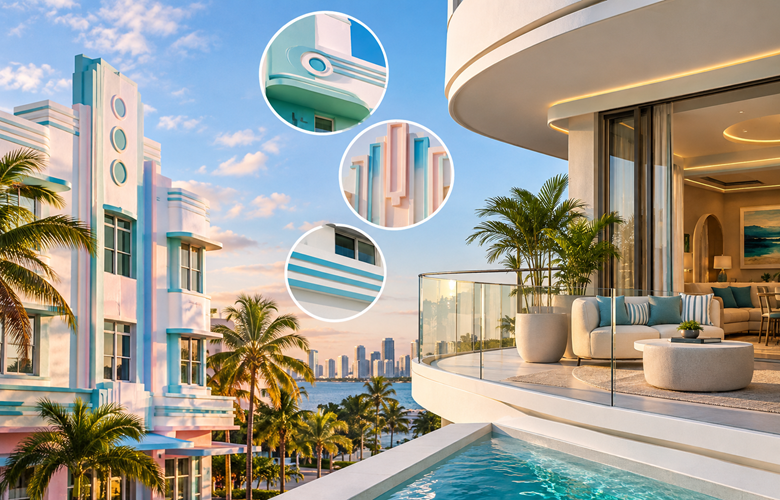
Miami Art Deco Architecture in Indian Homes is the 1930s and 1940s building style of Miami Beach, where a one-square-mile district holds more than 800 preserved historic buildings and, in 1979, became the first urban 20th-century district on the US National Register of Historic Places. Its local form, Tropical Deco, used window eyebrows for shade, rounded corners, porthole windows and nautical details. Modern residential design reuses these ideas through deep balcony slabs, curved facades, and vertical fins, which suit hot Indian cities such as Gurgaon, where shading reduces heat gain.
Miami Art Deco Architecture History
Art Deco began in France and gained worldwide attention by 1925, so the movement completed 100 years in 2025. Miami Beach rebuilt in the late 1920s and adopted the style through the 1930s.
Architects Henry Hauser and L. Murray Dixon led that wave with compact stucco hotels and apartment blocks. These buildings were smaller and cheaper to build than the grand resorts that came before them, making the style practical for a fast-growing leisure town.
By the mid-1970s, many of these buildings were decaying. Barbara Capitan and designer Leonard Horowitz started the preservation campaign in 1976, and Horowitz repainted many restored facades in the pastel tones that now define the South Beach postcard. Much of that colour scheme is a preservation-era layer, while the shading devices and geometry are original to the 1930s.
Art Deco Architecture Characteristics and Features in Miami
The Miami version of Art Deco is recognised by 8 features that appear again and again along Ocean Drive and Collins Avenue:
- Eyebrows: thin shelves above windows that shade the glass and cool the room inside.
- Rounded corners and streamlined curves: walls that wrap around corners and give buildings the look of a ship or train.
- Porthole windows: circular openings, seen at the Essex House, that add a nautical touch.
- Vertical emphasis: rectangular framing and jutting towers that stress height.
- Glass block and metal railings: materials that let light in while screening the view.
- Flat roofs and stucco walls: plain surfaces finished with low-relief floral and sunrise motifs.
- Mosaic tile and coloured glazed brick: durable colour on entrances and bases.
- Neon: lit signs and towers that make the district glow after dark.
Modern Art Deco Architecture in Residential Buildings
In new apartment towers, the eyebrow becomes a deep balcony slab or a horizontal fin that shades the floor below. The function is the same as in 1930s Miami: keep direct sun off the glass.Miami Art Deco Architecture in Indian Homes.
Rounded corners reappear as curved balcony edges and softened tower corners, which break up the boxy outline of a tall block. Vertical framing turns into fins and framed window bays that give a tower a clear rhythm from the street.
Glass block has a modern successor in fluted glass and screened balconies, both used where privacy matters as much as daylight. Neon gives way to concealed LED lines along facade edges, and the porthole survives as a single round opening in a lobby or clubhouse wall.
Modern Art Deco Interior Design in Lobbies and Clubhouses
Inside, Miami Deco relied on hard, decorative surfaces. The Senator Hotel on Collins Avenue, built in 1939 and demolished in 1988, had original terrazzo floors, a lobby desk made of Florida keystone and lobby glass etched with flamingos and palm trees.
Residential projects translate this into patterned stone or terrazzo floors in entrance lobbies, etched or fluted glass panels in clubhouses and stone reception counters.
Art Deco Vs Streamline Moderne
Streamline Moderne, also called Art Moderne, is the later phase of Art Deco, and much of Miami Beach’s 1930s building boom used it. It favours horizontal bands, rounded corners and forms that evoke ships, trains and cars.
Earlier Art Deco leans on vertical lines, zig-zags, sunbursts and rich materials such as marble and chrome. For apartment towers, the Streamline side is the more useful reference, because its horizontal bands line up naturally with stacked balcony slabs.
Art Deco Architecture in India
India has its own Deco history. Mumbai holds the world’s second-largest collection of Art Deco buildings after Miami, and the Victorian Gothic and Art Deco Ensembles of Mumbai became a World Heritage Site in 2018.
Bombay’s Deco grew in the 1930s along the Backbay reclamation, with seafront apartment blocks on Marine Drive showing rounded balconies, streamlined forms and pastel facades. Local architects added lotus motifs and temple spire profiles, a blend often called Indo-Deco.
Miami Art Deco Style for Hot Climate Homes
Gurugram recorded 48.1°C on 15 May 2022. In summers like that, the Miami eyebrow works as part of a building rather than an ornament.
India’s residential energy code, Eco Niwas Samhita 2018, issued by the Bureau of Energy Efficiency, treats overhangs and side fins as shading tools and lowers the calculated solar heat gain of windows that have them. The code caps envelope heat gain, measured as RETV, at 15 W/m² for composite, hot-dry, warm-humid and temperate climates.
That is the same idea Miami’s architects used in the 1930s. Deep balconies and horizontal slabs on west and south faces keep direct sun off the glass before it can heat the rooms behind it.
Miami-Inspired Luxury Homes on Golf Course Extension Road
On 4 March 2026, Godrej Properties disclosed that it had acquired 11.36 acres in Sector 63A, Gurugram, for a mix of low-rise and high-rise residences, with an estimated revenue potential of over ₹4,500 crore.
The developer describes the project, Godrej Verano Sector 63A, as inspired by the energy, spirit and sun-soaked lifestyle of Miami. Plans include 4 towers, 3, 4 and 5 BHK residences and 3 clubs, and our guide to Miami-inspired homes covers the planning and amenity side.
From the site, Golf Course Road is about 15 minutes away, AIPL Joy Street about 8 minutes, the Sector 55-56 Rapid Metro station about 15 minutes and IGI Airport about 35 minutes.
How to Check Art Deco Design Before Buying an Apartment?
Our team uses 5 questions to judge whether a Deco-inspired tower, including homes at Godrej Verano Gurgaon, uses the style for comfort or only for looks:
- How deep are the balcony slabs and window hoods on the west and south faces?
- Do the curved balconies add usable floor area, or are they only decorative edges?
- Which hard finishes, such as stone or terrazzo, go into the lobby and clubhouse floors?
- How often will the facade be cleaned and repainted, and how is that cost covered in maintenance?
- Is facade lighting concealed and on a timer, or exposed strips that are hard to replace?
Ask for facade sections and elevation drawings during the site visit, since renders rarely show shading depth. A project that answers these points clearly is using Deco design to make homes more comfortable, and that is the influence worth paying for.
“Ask what shades the glass before you ask what colour the facade is.”
The Deco Lesson in 4 Points
The Miami influence that matters in a modern home is practical: shade, proportion and durable finishes.
- Judge a Deco-inspired tower by its balcony depth and window shading on the west and south faces before you look at colour.
- Check the lobby and clubhouse finishes, because hard surfaces like stone and terrazzo are where Deco interiors last longest.
- Ask for elevation drawings and the facade maintenance plan at the site visit, since renders rarely show either.
- For the Miami-inspired plan at Godrej Verano Sector 63A Golf Course Road, you can see location, configurations.
Take these points to your next site visit and compare every Miami-inspired project on the same terms.
Read more blogs: https://www.veranosector63gurgaon.com/blog
Frequently Asked Questions
Why is Miami famous for Art Deco architecture?
Miami Beach has the world’s largest concentration of Art Deco architecture, built mostly during its 1930s growth. You can see it best on Ocean Drive, where restored hotels face the beach and glow with neon at night. The district also hosts Art Deco Weekend every January, with free guided tours, classic cars and films.
What colours are used in Miami Art Deco buildings?
Miami Art Deco buildings mostly use pastel pink, blue, purple, green, and yellow. Much of this palette came from repainting during the preservation years, and it later became South Beach’s signature look. When you judge a Deco-inspired home, look at its shading and geometry first, because you can repaint it in any shade.
What is an eyebrow in Art Deco architecture?
An eyebrow is a thin, projecting shelf above a window that shades the glass and keeps the room cooler. You will find eyebrows on most Tropical Deco buildings in Miami Beach. In a modern apartment tower, the same job is done by deep balcony slabs, horizontal fins and window hoods on the sun-facing sides of the building.
What is the difference between Art Deco and Art Nouveau?
Art Nouveau came first, roughly from 1880 to 1914, and uses flowing, nature-inspired lines such as the whiplash curve. Art Deco followed World War I, peaked in the 1920s and 1930s, and uses geometric shapes, zig-zags and polished materials like steel, aluminium and glass. You can spot Deco by its straight lines and symmetry.
How is Art Deco used in modern homes?
You will mostly see Art Deco in modern homes as shapes and finishes rather than heavy ornament. Common examples are curved balcony edges, vertical facade fins, patterned stone or terrazzo lobby floors, fluted glass screens, metal detailing and concealed facade lighting. These elements give a building Deco character while keeping maintenance simpler than original 1930s decoration.
Where can you see Art Deco architecture in Mumbai?
You can see Mumbai’s best Art Deco buildings around Marine Drive, Oval Maidan, Churchgate and Colaba, with more in Dadar and Matunga. The 1930s cinemas Regal, Eros, Metro and Liberty are well-known examples. The Oval Maidan and Marine Drive ensemble is part of a UNESCO World Heritage Site inscribed in 2018.
Does Art Deco design suit Gurgaon’s climate?
Yes, Art Deco shading suits Gurgaon because the city has very hot summers and strong afternoon sun. Deep ledges and balcony slabs over your windows block direct sun before it reaches the glass. India’s residential energy code also credits overhangs and fins with reducing window heat gain, supporting the same design idea.
Is Godrej Verano inspired by Miami design?
Yes, the developer describes Godrej Verano Sector 63A Gurgaon as inspired by the energy, spirit and sun-soaked lifestyle of Miami. It’s on Golf Course Extension Road and features 4 towers, 3, 4, and 5 BHK residences, and 3 clubs. Location details

Considering Godrej Verano, Sector 63A Gurgaon?
Floor plans, pricing and payment plan on request.
Related reading
How Architecture and Natural Light Influence Luxury Living in Gurgaon
Natural light shapes luxury living in Gurgaon through three key architectural choices: window orientation, glazing area and external shading. India’s national energy code assigns north-facing glass…
Read more →
Can Resort-Inspired Living Change the Way People Choose Luxury Homes in Gurgaon?
Yes, Gurgaon buyers now evaluate Resort Style Apartments in Gurgaon based on land-use data rather than amenity lists alone. In H1 2026, the average home ticket…
Read more →